Texas window tinting laws set clear darkness limits, but a wrong guess in Bryan can bring tickets or film removal. Shade-Ez installs window tint in Bryan and College Station, so this guide explains each rule in plain language for drivers. It covers the windshield, side windows, and rear glass using Texas statutes and Texas Department of Public Safety (DPS) guidance.
Table of Contents
- What Do the Texas Window Tinting Laws Allow in 2026?
- What Is Visible Light Transmission (VLT) in Simple Terms?
- What Are the Tint Rules for Each Window in Texas?
- Is 70%, 50%, 35%, 20%, or 5% Tint Legal in Texas?
- Are Reflective, Mirrored, and Colored Tints Legal in Texas?
- How Do Side Mirrors Affect Rear Window Tint in Texas?
- Does Factory Privacy Glass Count as Window Tint in Texas?
- How Do Medical Exemptions Work for Window Tint in Texas?
- Do Tint Labels, Inspections, and Fines Apply in Texas?
- Which Vehicles and Drivers Fall Outside the Texas Tint Rules?
- Did Texas Change Its Window Tint Law for 2026?
- How Can Drivers Check That Existing Tint Is Legal?
- How Can Drivers Pick Legal Tint That Still Handles Texas Heat?
- Which Tint Percentages Work on Each Window in Texas?
- Conclusion
- Frequently Asked Questions
What Do the Texas Window Tinting Laws Allow in 2026?
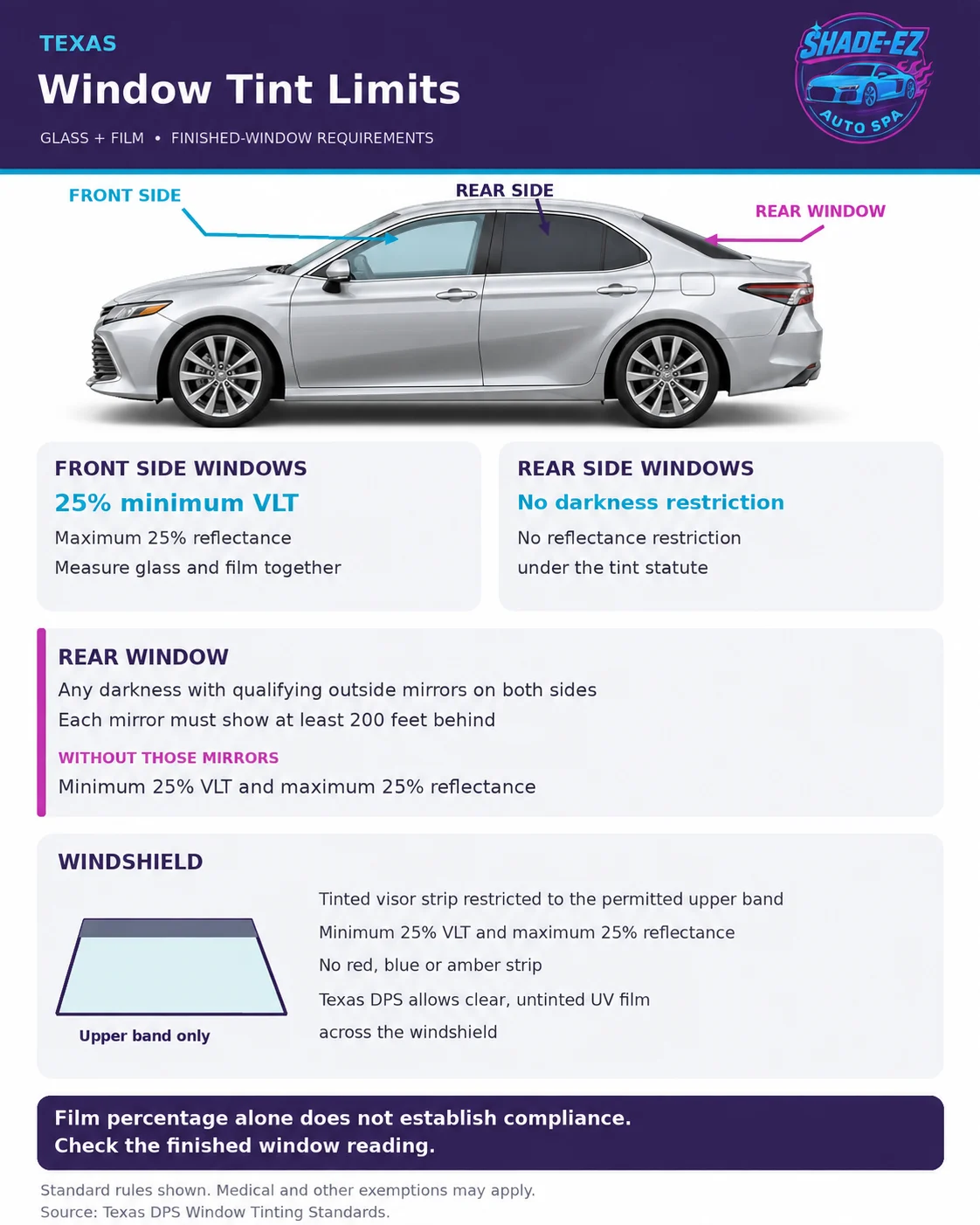
Texas Transportation Code Section 547.613 controls tint on vehicles registered in the state. Front side windows and the windshield strip must let in at least 25% of light. Rear side windows have no darkness limit.
This guide was checked against the Texas statutes and the DPS tint page in October 2026. Both still use the 25% standard, and the table below shows the main rules.
This guide offers general information, not legal advice. The sections that follow explain each rule in more detail.
| Window | Texas requirement | Where it comes from |
|---|---|---|
| Windshield | Tint strip only, above the AS-1 line or within 5 inches of the top, whichever is closer to the top. At least 25% light transmission and 25% reflectance or less. Not red, blue, or amber. | Transportation Code 547.613(b)(1) |
| Front side windows and wing vents (left and right of the driver) | At least 25% light transmission and 25% reflectance or less. | Transportation Code 547.613(b)(2) |
| Rear side windows | No darkness or reflectance limit. | Transportation Code 547.613(b)(2-a) |
| Rear window | No limit when outside mirrors on both sides show the road for at least 200 feet to the rear. Without them, DPS applies the 25% standard. | Transportation Code 547.613(b)(3) and DPS |
| Medical need | Defense to prosecution when a driver or passenger must be shielded from direct sun. | Transportation Code 547.613(e) |
What Is Visible Light Transmission (VLT) in Simple Terms?
Visible light transmission, or VLT, is the percentage of visible light that passes through a window. A 25% VLT lets in 25% of light and blocks 75%, so a lower number means a darker window.
Texas measures the finished window, not the number on the film box. The statute says the sunscreening device must meet its limit “in combination with” the glass. Glass and film stack, so a 35% film on glass that already blocks some light can read below 35%.
Bryan and College Station drivers can ask Shade-Ez to compare film darkness with the legal limit before an install. The final reading on the glass is what counts, so front window film should leave a margin above 25%.
What Are the Tint Rules for Each Window in Texas?
Windshield Tint Rules in Texas
Texas does not allow tint across the full windshield. A strip is allowed above the AS-1 line or within 5 inches of the top, whichever is closer. DPS says that when a windshield has no AS-1 line, the strip must end 5 inches below the top.
The strip must pass at least 25% of light, reflect no more than 25%, and avoid red, blue, or amber. The AS-1 line is a marking near the upper edge of most windshields.
The statute targets materials that change color or reduce light transmission. Owners should ask an installer to confirm any clear film before it goes on a windshield.
Front Side Window Tint Rules in Texas
The windows to the left and right of the driver must keep a combined light transmission of 25% or more. Wing vents follow the same rule, and the front passenger window counts, as does the driver’s window.
Reflectance on these windows must stay at 25% or less. Film that lets in less than 25% of light, measured with the glass, is not allowed on these windows.
Rear Side Window Tint Rules in Texas
Texas sets no darkness or reflectance limit on side windows behind the driver. Section 547.613(b)(2-a) exempts these windows, and the same exemption covers sedans, SUVs, trucks, and vans.
This is where very dark privacy tint, such as 5%, is legal under Texas law.
Rear Window Tint Rules in Texas
Rear glass can carry any darkness when the vehicle has an outside mirror on each side. Each mirror must show the road for at least 200 feet to the rear. Without both mirrors, DPS applies the same 25% standard used on the front side windows.
Is 70%, 50%, 35%, 20%, or 5% Tint Legal in Texas?
Each answer depends on the window, and the numbers below describe the final reading with film and glass measured together.
Is 70% tint legal in Texas?
Yes, 70% tint is legal on front side windows because a 70% reading is lighter than the 25% minimum. On the windshield, it is still limited to the strip above the AS-1 line.
Is 50% tint legal in Texas?
Yes, 50% tint is legal on front side windows. A 50% film leaves room for the glass to block some light and still stay above 25% in most cases. The final reading should be confirmed on the window.
Is 35% tint legal in Texas?
It depends on the glass. With factory glass at 70% and film at 35%, the combined reading is about 24.5%.
That falls short of 25%, though every vehicle’s glass is different. Behind the driver, 35% is allowed.
Is 20% tint legal in Texas?
No, 20% tint is not legal on the front side windows, because 20% is below the 25% minimum. It is legal on rear side windows and on the back glass when both outside mirrors meet the 200-foot test.
Is 5% tint legal in Texas?
No, 5% tint is not legal on the front side windows or the windshield. It is legal on rear side windows and on the rear window when both side mirrors meet the 200-foot test.
Within about 60 miles of Bryan and College Station, Shade-Ez tints commuter cars, pickups, and SUVs alike. Drivers who want a legal film plan can review window tinting in Bryan and College Station before choosing a shade.
Are Reflective, Mirrored, and Colored Tints Legal in Texas?
Texas limits luminous reflectance, which is how much light bounces off the glass. The windshield strip and the front side windows must reflect 25% or less. The statute sets no reflectance limit for rear side windows.
Red, blue, and amber are banned on the windshield strip, while the front side clause lists no color ban. A mirror-like or colored film can still fail the reflectance number, so the reading matters more than the look.
Bryan & College Station, TX
Plan a Legal Front Window Tint
Choosing film for front windows in Bryan or College Station, Texas? Call (979) 481-8468 to plan a darkness level that clears the 25% limit. The plan accounts for existing glass, confirms the final reading, and cuts cabin heat in long Brazos Valley summers.
How Do Side Mirrors Affect Rear Window Tint in Texas?
Texas exempts a tinted rear window when the vehicle has an outside mirror on each side. Each mirror must reflect a view of the highway for at least 200 feet to the rear. That mirror test is what gives rear glass its freedom.
Drivers who remove mirrors, or swap them for ones that do not show 200 feet, could lose that exemption. Texas applies the same mirror test to cars, SUVs, trucks, and vans. The statute sets no separate tint limit by body style.
Does Factory Privacy Glass Count as Window Tint in Texas?
Factory privacy glass is darkened during manufacturing, so it is not an added film. Texas exempts windows that meet federal standards, including factory-tinted windows installed by the manufacturer. Replacement windows that meet the maker’s specifications are also covered.
Aftermarket tint is different because it is a film applied after the vehicle leaves the factory. The statute makes placing that film an offense unless an exemption applies.
Film over factory privacy glass on a front window is still aftermarket film, so the combined reading must reach 25%. Behind the driver, the rear side window exemption applies either way.
How Do Medical Exemptions Work for Window Tint in Texas?
Texas law gives a defense when a driver or passenger must be shielded from direct sun for a medical reason. Section 547.613(e) states this as a defense to prosecution. The statute does not list qualifying conditions or set a darkness limit.
DPS says the proof is a signed statement from a licensed physician or licensed optometrist. The Texas DPS window tinting standards page also says DPS stopped issuing window tint exemption certificates on January 1, 2019.
The statement should name the person and confirm the tint is needed for health. DPS says to carry it in the vehicle.
Do Tint Labels, Inspections, and Fines Apply in Texas?
Required Tint Label
Section 547.609 requires a legible label that shows light transmission and reflectance information. It must state that the film is consistent with Section 547.613(b)(1) or (2). It must also sit permanently between the film and the glass.
DPS adds that the label belongs on the rearmost, bottom corner of the driver’s side window. The text reads “Complies with TRC Chapter 547” or “Complies with TTC 547.613 (b)”.
A business that installs film without a compliant label commits a misdemeanor, and the fine can reach $1,000.
Inspections After 2025
DPS says non-commercial vehicles no longer need a safety inspection before registration as of January 1, 2025. Commercial vehicles still do.
The tint rules in Section 547.613 remain in the Transportation Code. An officer can still cite a violation on the road.
Fines and Penalties
Section 547.613 lists no separate fine for drivers. Under Section 542.401, a misdemeanor in that subtitle with no other penalty carries a fine of $1 to $200. Court costs can add to the total.
For charges brought under the general equipment offense in Section 547.004, a court may dismiss the charge. The defect must be fixed before the first court appearance, and a reimbursement fee of up to $10 applies. That option does not apply to commercial motor vehicles.
Which Vehicles and Drivers Fall Outside the Texas Tint Rules?
Section 547.613 does not set different darkness limits for sedans, SUVs, trucks, or vans. The same window-by-window rules apply to each.
The statute exempts law enforcement vehicles and for-hire passenger vehicles licensed by a local authority. It also exempts commercial motor vehicles as defined in Section 644.001 and motor vehicles not registered in Texas.
That last exemption matters near Texas A&M, where some students and visitors drive vehicles registered in other states. It stops once the vehicle is registered in Texas, and the Texas limits then apply.
Did Texas Change Its Window Tint Law for 2026?
Some tint sites claim Texas lowered the front side window limit from 25% to 20% on January 1, 2026. The statute text on the Texas Legislature website still says 25%, and its amendment history ends in 2009. The DPS tint standards page also lists 25%.
A 2025 bill, HB 1126, would have added a tint exemption for vehicles with judicial plates. It passed the House but died in the Senate, so it did not change the law.
Treat any claim that lacks a bill number or statute citation as unverified. Owners should check the current statute before buying film.
How Can Drivers Check That Existing Tint Is Legal?
A short checklist helps before a trip to the shop or a traffic stop:
- Identify the window position, since each position has its own rule.
- Look for the compliance label at the rearmost, bottom corner of the driver’s side window.
- Ask an installer for a light-transmission reading for each front window.
- Confirm both outside mirrors show at least 200 feet to the rear if the back glass is tinted.
- Keep any signed medical statement in the vehicle.
How Can Drivers Pick Legal Tint That Still Handles Texas Heat?
This section is tint-industry guidance, not Texas law. Darker film is not the only way to cut heat.
Ceramic and other heat-rejecting films block infrared and ultraviolet light. A lighter film on the front windows can still add comfort. Ceramic film usually costs more than dyed or carbon, and our guide to dyed, carbon, and ceramic window tint costs shows the typical range for each.
Brazos Valley drivers spend long summer days in parked vehicles, which makes heat control a daily concern. Front window film should leave room above 25%. Confirm the final reading before the car leaves the shop. Film type and the windows covered also change the price, and our Bryan window tinting cost guide shows typical 2026 ranges.
Which Tint Percentages Work on Each Window in Texas?
The table compares common final readings, which mean film and glass measured together, with each window position.
| Final reading | Front side windows | Rear side windows | Rear window | Windshield strip |
|---|---|---|---|---|
| 70% | Legal | Legal | Legal | Legal |
| 50% | Legal | Legal | Legal | Legal |
| 35% | Legal | Legal | Legal | Legal |
| 25% | Legal (minimum) | Legal | Legal | Legal (minimum) |
| 20% | Not legal | Legal | Legal with two 200-foot mirrors, otherwise not legal | Not legal |
| 5% | Not legal | Legal | Legal with two 200-foot mirrors, otherwise not legal | Not legal |
Conclusion
Texas window tinting laws come down to a few numbers. Front side windows and the windshield strip need 25% or more light and 25% or less reflectance. Rear side windows have no limit, and the rear window is free when both mirrors show 200 feet.
Bryan and College Station drivers can use Shade-Ez to apply those limits to real vehicles. Drivers who also want gloss and surface protection can explore ceramic coating in Bryan alongside a legal tint plan.
Bryan, TX
Tint Without Risking a Ticket
Ready to tint a Texas vehicle without risking a ticket or film removal? Call Shade-Ez at (979) 481-8468 or visit the shop at 1502 S Texas Ave in Bryan. Ask for a film plan that meets the 25% rule and cuts heat across Bryan, College Station, and nearby towns.
Frequently Asked Questions
What is the darkest legal window tint for front side windows in Texas?
The darkest legal tint for front side windows in Texas is 25% light transmission, measured with the glass. Reflectance must also be 25% or less. Because film and factory glass stack, a 35% film can fall below 25%. Ask the installer for a final reading on each front window before the install.
Is 20% tint legal in Texas?
No, not on front side windows, since 20% is below the 25% minimum in Section 547.613. It is legal on rear side windows, and on the rear window when both outside mirrors show 200 feet. Claims of a 2026 change to 20% have no bill or statute behind them, and the posted statute text still lists 25%.
Is 5% tint legal in Texas?
No, not on the front side windows or the windshield. It is legal on rear side windows, which have no darkness limit, and on the rear window when both outside mirrors show at least 200 feet of road. Without those mirrors, DPS applies the same 25% standard to the back glass. Check the mirrors first.
Can I tint my whole windshield in Texas?
No, Texas allows a tint strip only above the AS-1 line or within 5 inches of the top, whichever is closer. The strip needs 25% light transmission or more and 25% reflectance or less, and it cannot be red, blue, or amber. Ask an installer to confirm any clear film before it goes on the windshield.
Do I need a medical exemption certificate for dark tint in Texas?
No, DPS stopped issuing window tint exemption certificates on January 1, 2019. Texas law gives a defense when someone must be shielded from direct sun, and DPS points to a signed statement from a licensed physician or optometrist. Carry that statement in the vehicle and show the installer.
How much is a window tint ticket in Texas?
Section 547.613 lists no separate fine for drivers, so the general misdemeanor range of $1 to $200 under Section 542.401 applies, plus court costs. Installers who skip the required label face a fine up to $1,000. Fixing the tint early can matter if the charge falls under Section 547.004.